
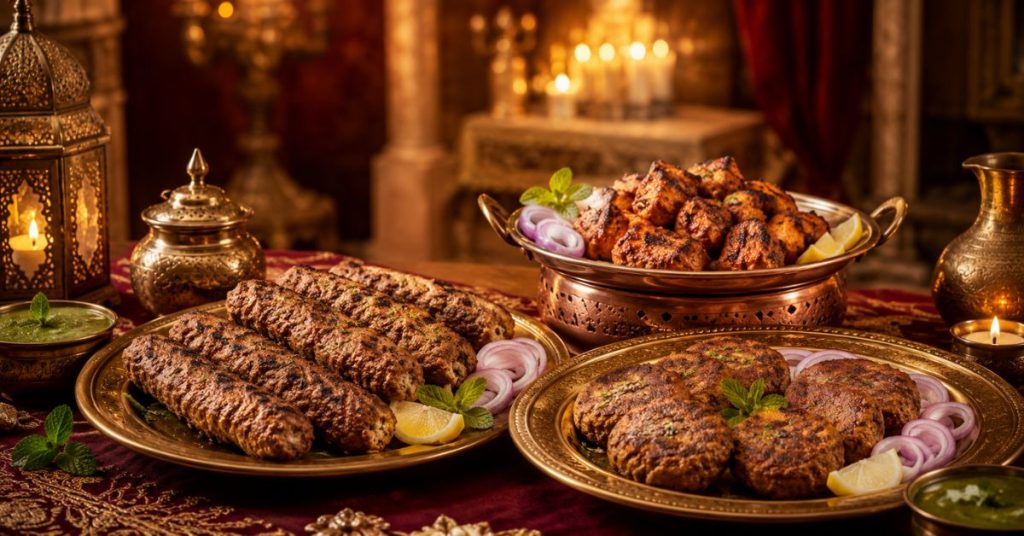
Order a seekh kebab, malai kebab or tandoori tikka today and it is easy to think mainly about the smoke, spice and tenderness on the plate. Yet many traditional Indian kebab recipes carry something less obvious: the history of royal kitchens.
Indian kebabs developed through centuries of movement between Persian, Central Asian and South Asian food cultures, then took on new identities in Mughal courts and regional royal households such as those of Awadh. Court cooks did more than grill meat. They refined texture, controlled aroma, developed marinades and turned seemingly simple preparations into highly specialised dishes.
Understanding that history matters because “Mughlai” food is sometimes reduced to a vague idea of rich gravies and heavy spices. The royal culinary tradition was far more precise. Kebabs reveal that precision especially well.
Indian Kebabs Did Not Begin in a Single Royal Palace
It would be convenient to say that the Mughals invented Indian kebabs, but culinary history is rarely that simple.
Early forms of kebab travelled through interconnected food cultures spanning Iran, Central Asia and South Asia. People, recipes and cooking knowledge moved along with merchants, soldiers, administrators and court communities. Once these preparations reached different parts of the Indian subcontinent, local cooks adapted them to regional ingredients, tastes and techniques. Food historian Neha Vermani describes this wider early-modern food world as one shaped by movement and exchange rather than a single point of origin.
The Mughal contribution was therefore not the invention of grilled meat. It was the transformation and localisation of existing culinary traditions within one of South Asia’s most sophisticated court cultures.
That distinction helps explain why there is no single “traditional Indian kebab recipe.” Seekh kebab, Awadhi galouti, Punjabi tikka and other regional preparations may belong to the same broad family, but each represents a different stage in that culinary journey.
The Mughal Court Turned Kebab-Making Into a Refined Culinary Craft
Imperial kitchens were highly organised
By Emperor Akbar’s reign in the sixteenth century, food preparation had become an organised part of the imperial household. The Ain-i-Akbari, Abu’l Fazl’s account of Akbar’s administration, devotes specific attention to the imperial kitchen, its management and its food preparations. Mughal kitchens employed specialised personnel rather than treating cooking as an informal household activity.
Under Shah Jahan, kebabs were established firmly enough within elite cuisine to receive dedicated treatment in Nuskha-i-Shahjahani, a Persian culinary manuscript associated with his reign. Its sections cover breads, pulaos, stews, sweets and a distinct category of kabab.
That is an important detail. By this period, kebab was not merely meat placed over a fire. It belonged to a recognised culinary repertoire in which recipes, ingredients and methods could be differentiated and recorded.
Royal luxury was about precision, not simply stronger spice
Modern restaurant descriptions sometimes make “royal” food sound as though cooks simply added more cream, butter and spices. Mughal food culture was considerably more nuanced.
Aroma held particular importance. Mughal culinary practices made extensive use of fragrant ingredients and treated the sensory experience of eating as part of a sophisticated dining culture.
For kebabs, this courtly approach encouraged several qualities that remain important today: careful marination, controlled cooking, tenderness, balanced seasoning and a distinctive aroma from spices, fat and fire. A successful kebab did not need to overwhelm the palate. The more difficult achievement was making each flavour feel deliberate.
Awadh Changed What a Royal Kebab Could Be
If the Mughal court helped establish kebabs within elite North Indian cuisine, the kitchens of Awadh pushed refinement in a different direction.
During the eighteenth century, Lucknow became a major centre of Nawabi culture. Royal households employed specialised cooks, including rakabdars known for mastering particular dishes. Accounts of Lucknow’s culinary heritage describe multiple royal kitchens and a cooking culture in which specialisation became a mark of prestige.
The result was a style of kebab in which softness could matter as much as smoke.
Awadhi preparations such as galouti and kakori became famous for exceptionally fine textures. Instead of relying only on substantial pieces of meat exposed directly to intense heat, cooks could work with finely minced meat, carefully balanced fat, aromatic seasonings and tenderising techniques to create something almost delicate enough to dissolve on the tongue.
There is a famous story that an ageing, toothless Nawab demanded a kebab soft enough for him to eat, prompting his cooks to create the galouti. It is an irresistible piece of food folklore, but it should not be presented as unquestioned historical fact. Culinary historians have noted that many colourful stories surrounding Mughlai and Awadhi dishes became embellished over time. What is well established is the larger tradition: Lucknow’s courtly cooking placed extraordinary emphasis on texture, fragrance and specialised craftsmanship.
That distinction makes the real history more interesting, not less. Awadhi kebabs were shaped by an entire culinary culture rather than a single dramatic royal request.
Regional Courts Made the Kebab Distinctly Indian
The weakening of Mughal political authority did not mean the disappearance of Mughal-influenced cooking. Culinary knowledge continued to develop in regional courts and elite households across the subcontinent.
Bengal offers an especially revealing example. A later royal Bengali cookbook influenced by the culinary work of Shah Jahan’s chief cook reportedly contained 18 varieties of kebab, showing how thoroughly courtly kebab traditions could be absorbed and reinterpreted outside Delhi.
Similar processes of adaptation occurred elsewhere. Court traditions in Awadh, the Deccan, Kashmir, Punjab and other regions combined inherited techniques with different meats, local spices, available fuel and regional preferences.
This is why Indian kebab history should be understood as a branching family tree rather than a straight line from one Mughal emperor to today’s restaurant menu.
What Royal History Still Reveals in a Traditional Kebab Recipe
Many characteristics that distinguish one kebab from another make more sense when viewed through this history:
- Texture tells you the culinary lineage. Seekh kebabs rely on seasoned mince shaped around a skewer, while tikka-style kebabs preserve identifiable pieces of meat. Awadhi kebabs may take mincing and tenderisation much further to create an exceptionally soft result.
- Marination does more than add flavour. Dairy, spices and aromatics can season the meat while also changing its surface and tenderness, helping it withstand intense cooking without becoming dry.
- Aroma is as important as chilli heat. Cardamom, cloves, pepper, saffron, floral essences and other aromatics historically allowed cooks to build complexity without making every dish aggressively hot.
- Fat contributes to texture. The right amount can keep minced kebabs succulent and help carry aromatic flavours. Too much simply makes the dish heavy.
- Fire has to be controlled. Tandoor and charcoal cooking depend on high heat creating browning and smoke before the interior dries out.
These details explain why two dishes containing almost identical spices can still taste completely different. Traditional kebab-making is as much about physical technique as an ingredient list.
Reading Bukhara Singapore’s Kebab Menu Through This History
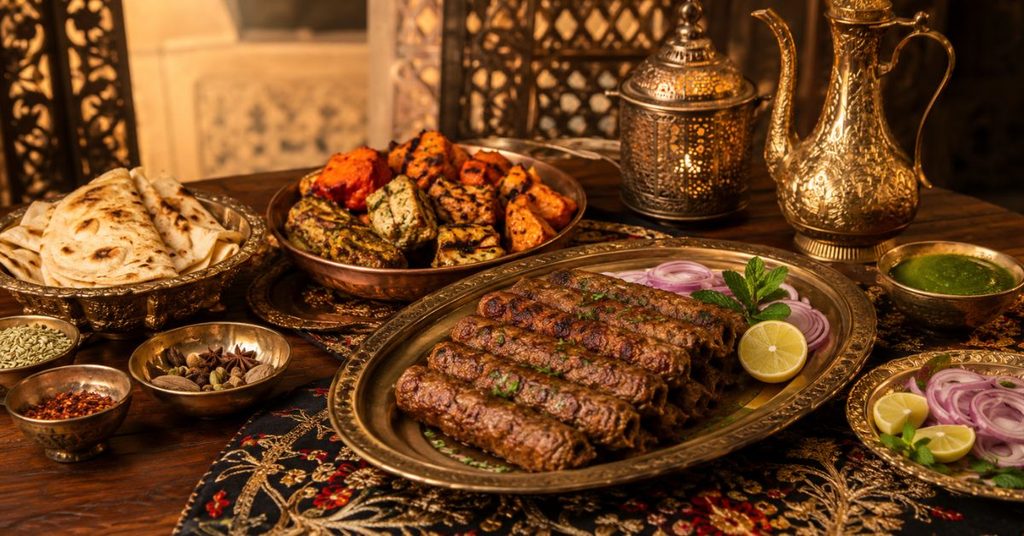
Rather than presenting every grilled dish under a single generic “Indian kebab” identity, the menu draws on multiple regional and royal references. House-Of-Patiala Murgh Tikka is associated with Punjab; Murg Malai Gulzar Kebab is connected with Uttar Pradesh and Lucknow; Sultanate Seekh Kebab draws attention to Persian-influenced royal food traditions; and Sufiyani Gulnar Paneer reflects a vegetarian expression within a menu inspired by historical Indian cooking.
The most useful way to understand such dishes is not to assume that every modern recipe is an unchanged palace formula preserved for hundreds of years. Traditional cuisines evolve. What survives is often a culinary logic: the use of skewers, marination, aromatic seasoning, live fire, careful tenderisation and regional interpretations of luxury.
The Lucknow connection behind a malai-style chicken kebab, for instance, makes sense when viewed alongside Awadh’s preference for softness and refinement. A Punjabi tikka points in a different direction, where high-heat grilling and the tandoor play a stronger role.
Why This History Matters to Indian Dining in Singapore
Singapore diners have access to Indian food traditions from many different regions, so describing everything simply as “North Indian” or “Mughlai” can hide meaningful differences.
Knowing the royal history behind kebabs helps diners recognise those differences. A Lucknow-inspired kebab should not be judged by exactly the same expectations as a Punjabi tandoori preparation. One may prioritise exceptionally soft texture and restrained aromatics; another may be defined by char, smoke and a firmer bite.
It also gives restaurants a more meaningful way to approach authenticity. Authenticity does not require freezing a recipe at some imagined moment in history. Indian kebabs became diverse precisely because generations of cooks adapted them.
What deserves preservation is the discipline behind the food: understanding the ingredient, choosing an appropriate marinade, controlling fire, building aroma carefully and respecting the regional character of the finished dish.
That philosophy fits naturally with Bukhara’s North-West Frontier cuisine and dining approach, where grilling traditions and food designed for sharing remain central to the experience.
Conclusion
The royal history behind traditional Indian kebab recipes is not a simple story in which one emperor’s chef invented a dish that remained unchanged forever.
Kebabs travelled across cultures before being refined in Mughal kitchens. Imperial cooks helped turn them into a sophisticated category of court cuisine. Awadhi kitchens then pursued extraordinary tenderness and aroma, while regional courts and communities created their own interpretations. Those adaptations eventually produced the enormous diversity diners recognise as Indian kebabs today.
That history also offers the best guide for their future. As Indian cuisine reaches increasingly international audiences, preserving kebab traditions should mean protecting their regional identities and techniques rather than reducing them to interchangeable pieces of spicy grilled meat.
A great kebab still depends on the same qualities royal cooks pursued centuries ago: thoughtful preparation, control of heat, balance of aroma and a texture deliberately created for the dish.
FAQs
Did the Mughals invent kebabs in India?
No. Kebab traditions had wider Persian and Central Asian connections before and during their arrival in South Asia. The Mughal courts helped refine, localise and formalise many kebab preparations.
Which Indian kebabs are most strongly associated with royal Awadhi cuisine?
Galouti and kakori kebabs are among the best-known examples. Both are associated with the highly refined cooking traditions of Lucknow and Awadh.
What is the main difference between seekh kebab and tikka?
Seekh kebab is generally made from seasoned minced meat formed around a skewer. Tikka uses pieces of meat or another main ingredient that are marinated and grilled.
Why are Lucknow-style kebabs so soft?
Awadhi kebab-making emphasises very fine texture, careful tenderisation, balanced fat and controlled cooking. These techniques create the signature melt-in-the-mouth character.