
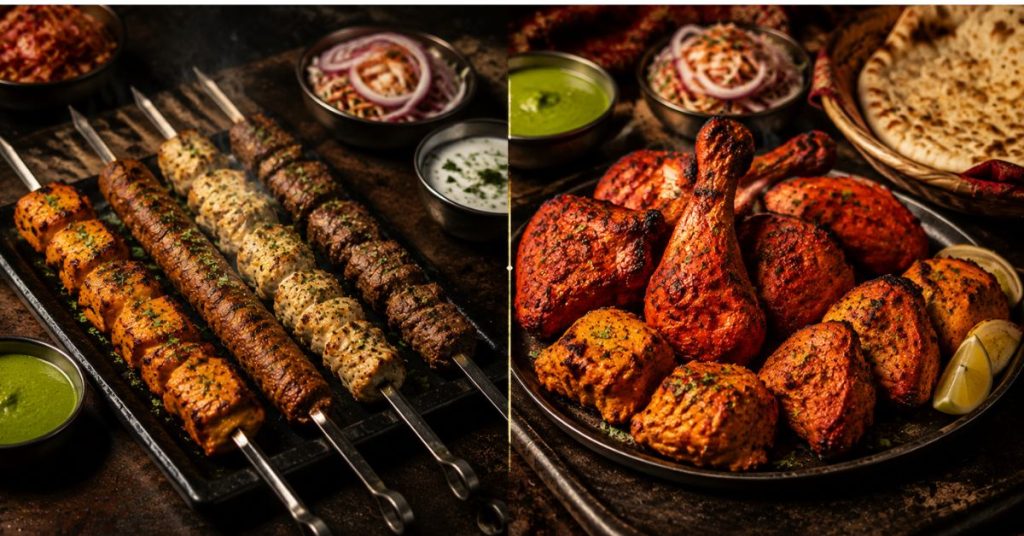
Kebabs and tandoori dishes often appear side by side on an Indian restaurant menu, and sometimes the same dish can seem to fit both descriptions. A chicken tikka may be listed among the kebabs, while tandoori chicken is cooked using a similar marinade and the same clay oven. So where is the actual difference?
The simplest answer is this: kebab is a broad family of dishes, while tandoori mainly describes a cooking method.
That distinction matters when ordering because it tells you much more than the name alone. Kebabs can be minced, cubed, skewered, shaped into patties or prepared using several different cooking techniques. Tandoori dishes, meanwhile, get much of their identity from the intense heat and distinctive character of the tandoor oven.
Understanding that difference makes it easier to choose dishes based on the texture, smokiness and style of food you actually enjoy.
The Main Difference: Dish Style vs Cooking Technique
Although kebabs and tandoori dishes frequently overlap, the words describe two different aspects of cooking.
Kebabs Are a Broad Family of Preparations
A kebab is generally a preparation built around seasoned meat, seafood, paneer or vegetables that are grilled, roasted or otherwise cooked to develop a savoury exterior. Skewered pieces are among the best-known versions, but Indian kebabs are far more varied than the familiar meat-on-a-stick image suggests.
Seekh kebabs, for example, are made by shaping seasoned minced meat around a skewer. Other kebabs may use whole chunks of meat, while varieties such as Galouti are formed into exceptionally soft patties rather than cooked as cubes on skewers. This variety is one reason the term “kebab” should be understood as a culinary category rather than one single cooking technique. Bukhara’s guide to the royal heritage of traditional Indian kebabs also highlights how different regional traditions created very different kebab styles.
Tandoori Describes Cooking in a Tandoor
“Tandoori” refers to food prepared using a tandoor, traditionally a cylindrical clay oven heated with charcoal or wood. The food is exposed to strong radiant heat as well as heat from the fire below, producing the roasted edges and smoky aroma associated with tandoori cooking. Oxford similarly defines tandoori as a method of cooking food on a spit in a clay tandoor.
This means tandoori can describe more than kebabs. Chicken, paneer, seafood and vegetables can all receive tandoori treatment, while naan and roti are also traditionally cooked inside the same oven.
That leads to the most useful rule to remember:
Some kebabs are tandoori, but not every kebab is tandoori. And not everything cooked in a tandoor is a kebab.
Why Kebabs and Tandoori Dishes Often Overlap
The confusion is understandable because many North Indian kebabs are cooked in a tandoor.
Chicken tikka is an obvious example. Pieces of marinated chicken may be skewered and cooked in the tandoor, making the finished dish both a kebab-style preparation and a tandoori preparation.
Bukhara’s Singapore restaurant menu demonstrates this overlap clearly. Its kebab selection includes House-Of-Patiala Murgh Tikka, Murgh Tandoori-Kebab Da Badshah, Murg Malai Gulzar Kebab and Nizams Murgh Seekh Bijapuri. Lamb options include Sultanate Seekh Kebab, while paneer appears as Sufiyani Gulnar Paneer.
The names may sit in the same menu section, but they describe different culinary ideas. “Seekh” tells you something about the preparation and shape. “Tandoori” tells you about the cooking environment. “Tikka” generally points towards pieces or chunks of the main ingredient.
Once you start reading Indian menus this way, the terminology becomes much easier to understand.
How the Cooking Method Changes Flavour and Texture
One of the most noticeable differences between kebabs and specifically tandoori dishes appears when you take the first bite.
Tandoori Cooking Creates Intense Char and Smokiness
The tandoor surrounds food with powerful heat. Instead of slowly cooking the surface, it can quickly roast and brown the exterior while the centre retains moisture when handled properly.
A good tandoori dish should therefore offer contrasting textures: lightly charred or blistered edges on the outside and tender meat, seafood or paneer within.
Smoke also plays an important role. Charcoal-fired tandoors create an aroma that cannot be reproduced simply by adding more masala. Bukhara’s guide to what makes tandoori chicken smoky, tender and flavourful explains how the combination of the tandoor, marinade and high heat creates that characteristic finish.
Kebabs Offer a Much Wider Range of Textures
Because kebabs are not restricted to one cooking method or one form, their texture varies dramatically.
A seekh kebab can be juicy and slightly springy because seasoned minced meat is shaped around the skewer. A malai-style chicken kebab can be exceptionally soft and creamy. Cubed tikka gives you more obvious roasted edges around individual pieces, while patty-style kebabs can be delicate enough to almost fall apart.
This makes kebabs especially interesting when ordering for a group: rather than simply choosing different meats, you can choose completely different textures and flavour styles.
Marinades Are Another Important Difference
Tandoori dishes and kebabs frequently share spices, but their marinades are not automatically the same.
Tandoori chicken is commonly associated with a yoghurt-based marinade supported by ingredients such as ginger, garlic and warming spices. The marinade has to perform particularly well under fierce tandoor heat: it should season the food, help retain tenderness and develop into a savoury coating rather than remain wet on the surface.
Kebab marinades are much more flexible. Depending on the style, they may use yoghurt, cream, herbs, spices, natural tenderisers or no yoghurt at all. With minced kebabs, ingredients can be mixed directly through the meat instead of applied as an exterior marinade.
As a result, two kebabs cooked in similar surroundings can still taste completely different.
For example, a creamy chicken kebab may emphasise mild richness and tenderness, while a seekh kebab depends more heavily on the seasoning, fat and aromatics mixed through the mince.
How to Tell What You Are Ordering
Menu terminology varies between restaurants, but a few practical clues can help:
- Look for “seekh” when you want seasoned minced meat formed around a skewer.
- Look for “tikka” when you prefer individual pieces or chunks with more roasted surface area.
- Look for “tandoori” when the live-fire clay-oven character is central to the dish.
- Do not assume every kebab is skewered. Indian kebab traditions also include patties and other shaped preparations.
- Do not judge tandoori food by red colour alone. The defining feature is the cooking technique and resulting char, aroma and texture, not simply the colour of the marinade.
These distinctions are more useful than trying to decide whether one entire category is automatically spicier or richer than the other. Spice levels depend much more on the individual recipe.
Should You Choose Kebabs or Tandoori Dishes?
Neither is inherently better. Your choice should depend on what you want from the meal.
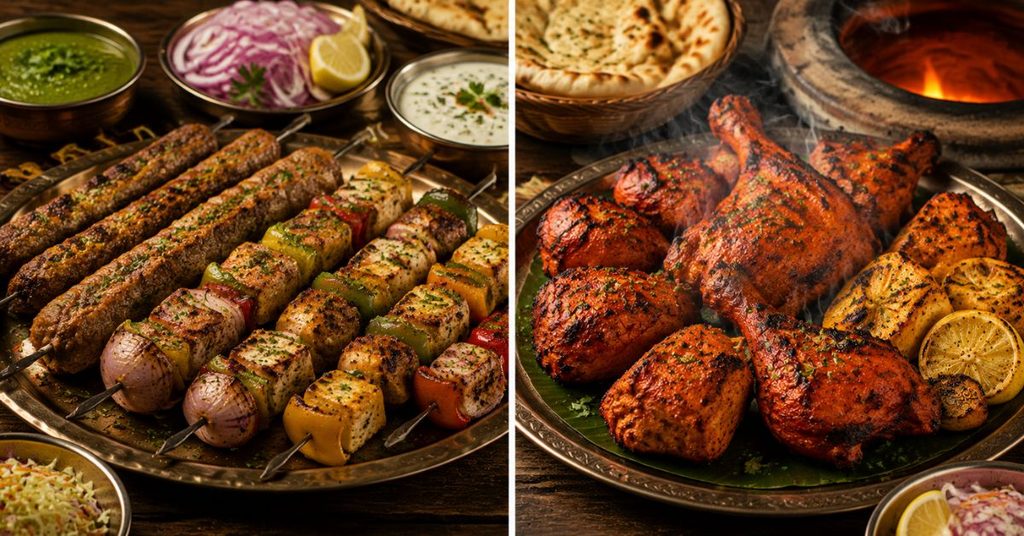
Choose a tandoori dish when you are especially looking for roasted flavour, noticeable char and the aroma of high-heat cooking. Tandoori chicken is a particularly good choice for diners who enjoy juicy meat with a smoky exterior.
Choose kebabs when variety matters more. The category allows you to move between minced seekh kebabs, creamy chicken preparations, paneer tikka, seafood and other regional styles without every plate feeling alike.
For a group meal, the best approach may be to combine them:
- Order a tandoori chicken or chicken tikka for pronounced char and smokiness.
- Add a seekh kebab to introduce the texture of seasoned minced meat.
- Include paneer or seafood for contrast.
- Choose a mixed platter when several people want to experience different kebab styles without ordering multiple full portions.
Bukhara’s menu, for instance, includes a non-vegetarian platter combining House of Patiala Murgh Tikka, Sultanate Lamb Seekh Kebab and Tamralipta Sarson Machilyan, giving diners several preparations within one course.
Tandoori Does Not Simply Mean “Indian Barbecue”
Calling tandoori food “barbecue” can be useful as a quick comparison, but it misses an important part of the technique.
A conventional grill primarily exposes food to heat from underneath. A tandoor creates a different cooking environment: food receives heat from the fire as well as intense radiant heat retained by the oven walls. Traditional breads can even be cooked directly against those hot walls.
That is why Bukhara’s menu includes not only meat dishes associated with the tandoor but also plain naan, garlic naan, butter naan, tandoori roti and other breads prepared using the oven.
The presence of tandoor-baked bread is a useful reminder that “tandoori” is fundamentally about the oven and technique rather than a particular spice blend.
How Bukhara’s Menu Brings Both Traditions Together
For diners in Singapore who want to experience the distinction rather than simply read about it, a menu with several regional preparations makes comparison easier.
Bukhara describes its cooking as being inspired by North-West Frontier traditions, with slow-cooked specialties, spices and tandoor-fired breads forming part of the restaurant’s identity.
Within the kebab selection, dishes move from chicken tikka and tandoori chicken to malai kebabs and minced seekh preparations. That variety demonstrates the central distinction particularly well: the tandoor is one powerful technique within a much larger kebab tradition, rather than another name for the tradition itself.
Conclusion
The difference between kebabs and tandoori dishes becomes straightforward once you stop treating the terms as competing food categories.
Kebab describes a broad family of preparations. Tandoori describes food cooked using the intense heat of a tandoor.
A kebab may be made from chunks, mince, paneer or seafood and can take several shapes and textures. A tandoori dish gets its defining character from the oven: concentrated heat, roasted edges, distinctive char and, traditionally, the aroma of live fire.
The two traditions often meet on the same skewer, which is why dishes such as tandoori kebabs and chicken tikka can legitimately belong to both worlds.
For diners in Singapore, understanding these distinctions makes ordering Indian food more interesting. Instead of choosing dishes simply by familiar names, you can start choosing according to technique, texture and flavour. As diners become increasingly familiar with India’s regional cooking styles, those differences are likely to become an even more important part of how authentic Indian menus are explored and appreciated.
FAQs
Is a kebab the same as a tandoori dish?
No. A kebab is a broad type of food preparation, while tandoori refers to food cooked in a tandoor. Some kebabs are cooked in a tandoor, so a dish can be both.
Are all kebabs cooked on skewers?
No. Seekh and tikka-style kebabs commonly involve skewers, but other Indian kebabs can be shaped into patties or prepared using different cooking methods.
What gives tandoori dishes their smoky flavour?
The smoky character mainly comes from the tandoor’s live-fire cooking environment, especially when charcoal is used. High heat also creates the browned and lightly charred exterior.
Which is spicier, kebab or tandoori?
Neither category is automatically spicier. The heat level depends on the marinade, spice blend and individual recipe.